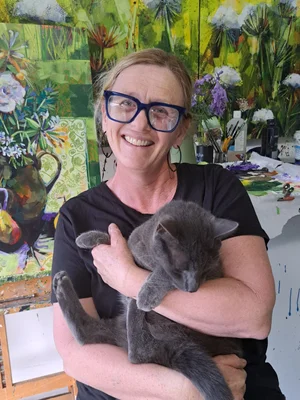
October saw me exhibiting a new collection of work at Field Trip Gallery in Paddington. This was a major body of work which had occupied most of my creative year. I was really proud of what I'd made, but also rather pleased that my original concept had worked out.
I'd set out to explore my new neighbourhood, and this had served two purposes. I'd been drawing and painting from life, making the work for the exhibition, while the experience had also fed directly into the development of my online course, The Tuesday Artist.
The course is essentially about how to be an artist. Its foundations took months of thinking, writing and shaping as I tried to work out how I actually do what I do, and keep doing it.
The practical elements of looking, collecting, connecting, transforming, building, assessing and sustaining became the pillars of the course.
Becoming an artist is an interesting process. When I sat down to consider everything I'd been taught, and everything I hadn't, I set myself the task of interrogating my own practice. How do I actually make art? How did I learn to do this thing I do?
I considered the essential parts of my process and whether I'd been taught them, or had somehow picked them up along the way.
I knew there were lessons which had stuck with me and were invaluable. I also knew there were many things I did that I'd somehow absorbed through making mistakes, going round in circles and eventually working things out for myself. There had been some lightbulb moments along the way.
One of the most important parts of my practice is drawing from observation. I look at something, assess it, and observe it very closely while I draw. It is something that has stayed with me since very early art school days.
For me, that's it. I was told to learn to look. Except nobody actually told me how a person does that.
I vividly remember a bunch of grungy art students standing in a big, draughty studio looking completely baffled, by this pronouncement.ent. I often imagine the tutors skipping back across to the pub, which was called The Yellow Rose (a hideous modern place), sniggering.
In hindsight, I also wonder whether some of the tutors’ approach was based on the idea of let's see who runs with this and who quits. Tough love, perhaps. They gave us the idea and it was essentially up to us to work it out for ourselves.
It was the mid-1980s, and nobody was particularly warm and fuzzy. Especially in Middlesbrough.
So, how do you actually learn to look?
The Tuesday Artist was conceived to help people develop a sustainable art practice. This is something I'm passionate about.
Over the years, I've seen so many students pass through my drawing and painting classes and then disappear. I knew they came to class wanting to make art, but once that regular structure of a weekly class was gone, so was the art-making.
I started thinking about the excuses people make and the reasons they believe they can't do something they really want to do.
Then I circled back to the big questions. How do you do this? How do you make authentic art? And, perhaps surprisingly, it isn't about talent.
I wanted to explain, as clearly as I could, how to see.
Learning to see like an artist is pure magic, and I wanted to understand how that happens and, more importantly, how to share it.
Trying to work out what happens inside your own brain is fascinating and frustrating in equal measure. Particularly when you've been making art since you were a small child. I knew I needed to explain how someone moves from copying photographs and other artists' work to making work that is authentically their own.
Telling someone to go out and look so they can see isn't terribly helpful.
Learning to look is about asking questions. Not random questions, but questions within a visual framework.
Using the ideas of variety, contrast and comparison to explore the elements and principles of art is one of the most reliable ways to begin.
So, how does that work?
By asking questions such as:
How dark is this compared to that?
How long is this compared to that?
How blue is this compared to that?
And so on.
It's about comparing, noticing differences and similarities, and becoming curious about what is actually in front of you.
Curiosity is a foundational trait for life as an artist. Look with curiosity. Record, collect, connect, transform, build, assess and sustain with an open, curious mind.
When I started writing the sections of my course that explored this idea of intentional looking - looking to find out - my own process became so much clearer.
I'd been doing this all along, but I hadn't really understood that I was doing it, or quite why. It had become second nature. Now, having worked out how to explain it, I've finally got it down on paper, and it makes sense.
Once I reframed looking as a way to discover, the purpose of drawing shifted too. Drawing became a means of exploring rather than simply producing an image. It became a verb, not a noun.
Drawing has been one of the biggest challenges for many of my students. By examining how and why I draw, I was able to explain that drawing isn't meant to be a performance or a competition. It doesn't need to be something you get right or wrong.
That removes some of the pressure and fear of judgement which drawing seems to inspire in otherwise perfectly competent adults.
When drawing is approached as a way to find out about something, as an intentional method of understanding, the whole process shifts.
And then there's the question of ideas.
Finding ideas is one of the things people often find hardest. They spend hours scrolling Instagram and Pinterest looking for inspiration. The truth is, so many ideas are already right there in front of them. They just need to learn how to look.
That became the impetus for The Tuesday Artist. I wanted to work out how to explain something I'd spent a lifetime doing, and turn it into a clear, practical path that would help other people develop the skills, confidence and freedom to make art of their own.
Because learning to look changes everything. And once you start, it's rather difficult to stop.